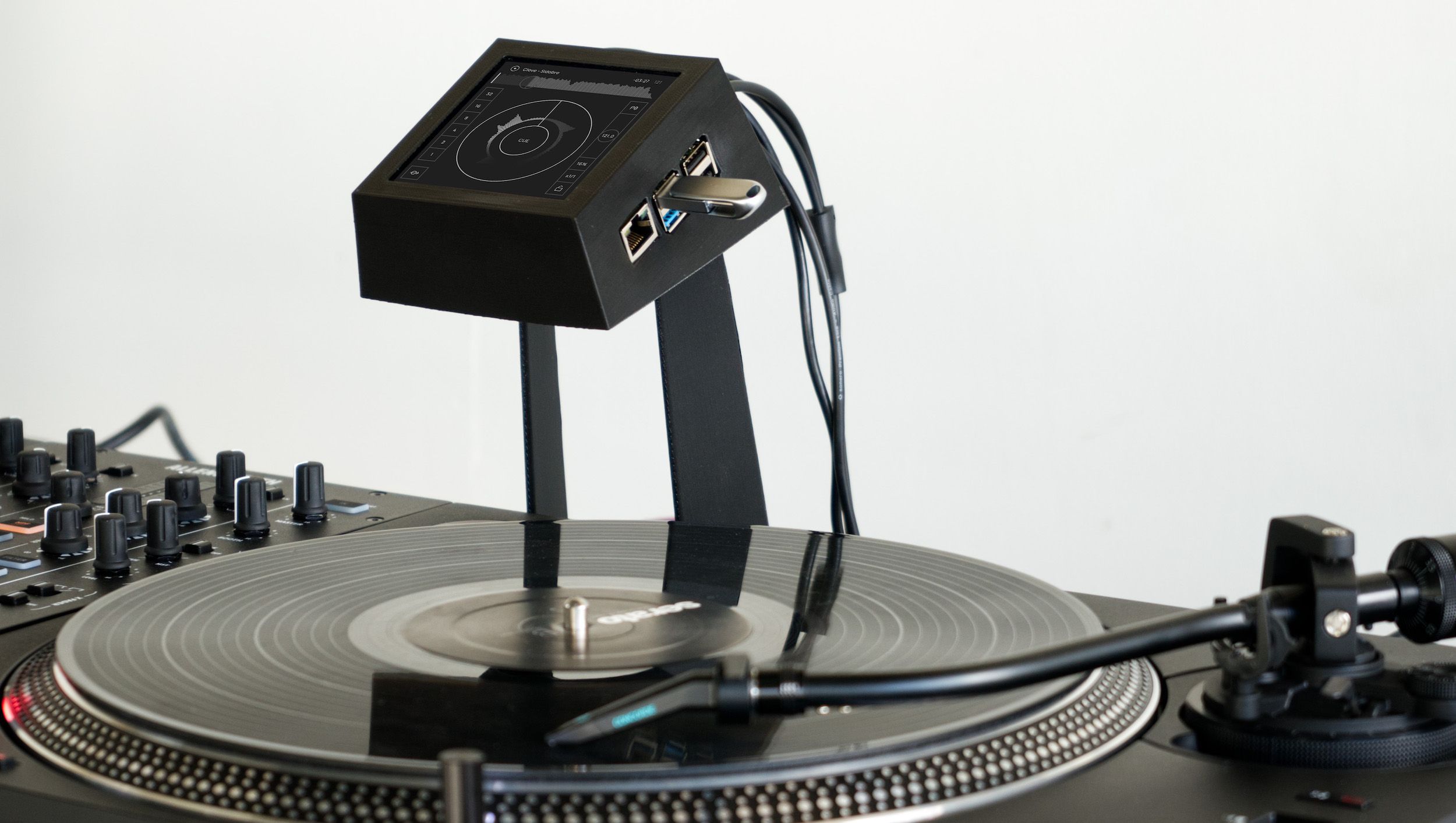
The Devious Pocket is a standalone Digital Vinyl System out of a small Amsterdam studio called NAP Works, and the headline feature is that it works without a laptop anywhere in the chain. Plug it in between your turntable and your mixer, drop a USB stick into the side, put on a timecode record, and you’re playing digital files through actual records with no library software and no operating system to babysit. €249 for a single unit (intro pricing on the first 100 made), €499 for a two-deck bundle with stands.
The project is on Indiegogo with four days left, around €21k raised from 36 backers.
Let’s dive a bit more into the details around the unit itself, and why DJs (even non-vinyl users) might care.
A laptop-free DVS rig?
The Devious Pocket is a small box with a 4″ touchscreen, a HifiBerry DAC, four USB-A ports, RCA in/out, USB-C power, and a gigabit ethernet port. Connect it between your turntable and your mixer, drop a timecode record on the platter, and the device plays whatever digital file you select from the USB. Scratch, pitch, and cue work the way you’d expect them to, because the control surface is the record itself.
The cabling stays minimal:
- One phono cable runs from the turntable into the device
- One line cable runs from the device out to your mixer
- and that’s the whole chain!
The phono pre-amp is built in, so flipping between digital playback and pure vinyl happens on the touchscreen instead of through patching cables on the back of the mixer.
Supported timecode formats are diverse too (so you can bring your own control vinyl): Serato 2, Serato CD, Traktor 1, Mixvibes V2 and 7, and Pioneer/rekordbox DVS. The unit can play audio filetypes mp3, flac, wav, aif, caf, and ogg. The output is 48kHz/24bit, with internal upsampling for lower-quality files. NAP Works claims a 0.666 ms internal processing latency thanks to a direct CPU-to-DAC path that skips USB framing entirely. That said, the real latency experience is always the kind of number that should be verified in a real-world test with a production unit.
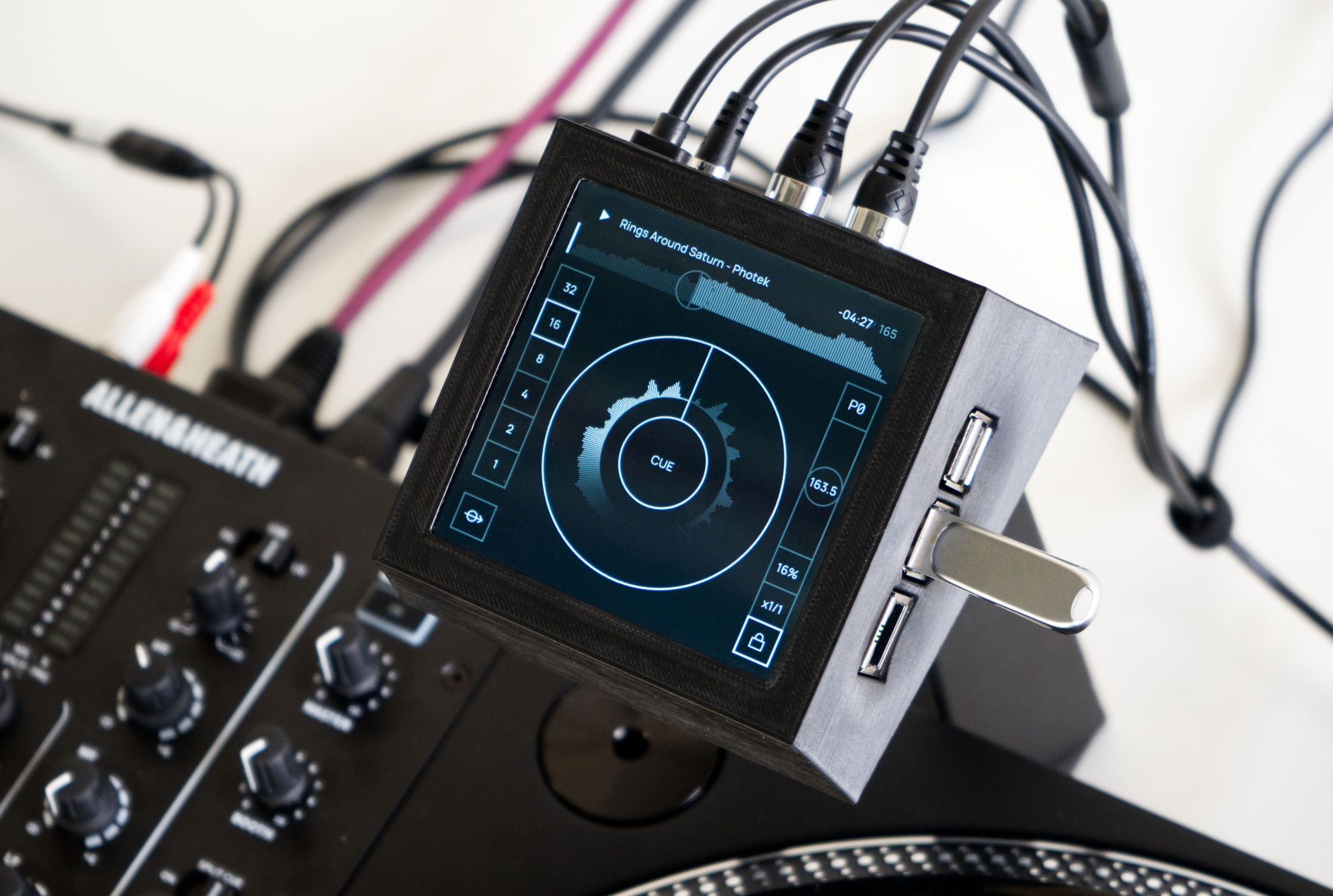
The feature set goes past just basic playback with DVS control. There’s looping from 1 to 32 bars, a BPM lock with auto-pitching when you load a new track (the software handles ½×, ?×, and 2× tempo relationships rather than dumping you out of sync), custom cue points, ID3-tag-based search and sort, a circular waveform display that visualizes each track with the same rotation as the record on the platter, and a digital phono pre-amp pass-through for playing actual pressed records through the same chain. Each device handles up to four USB drives connected simultaneously, so you can keep multiple libraries mounted without swapping sticks mid-set. Honestly, many of these are basic quality of life features that are sometimes missing on multi-thousand industry standard media players.
The BPM lock works in practice by setting your target tempo on the screen. From there, the turntable’s quartz-locked zero-pitch position corresponds to that BPM, and the pitch slider on the deck scales the track around it. Two decks locked to the same BPM end up tempo-synced without any timestretching artifacts to worry about.
The Devious Pocket has no physical buttons. Everything happens on the 4″ screen, which NAP Works defends as the turntable being the instrument and the touch interface is just there for selection and parameter tweaks. As with any piece of gear, you’d want to test in a dark booth before agreeing with this type of claim.
What changes when the laptop comes out of the booth
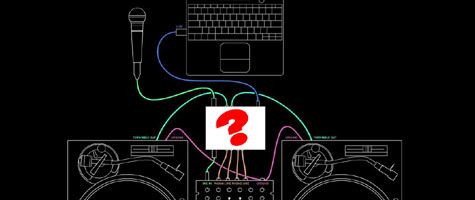
DVS has been around for roughly a quarter century at this point (shout out to Final Scratch in 2001), and the basic recipe has been the same for most of that run. DJs show up with a laptop, an audio interface, a tangle of cables, a copy of Traktor or Serato, and the a sense of background anxiety that comes with hoping that your laptop doesn’t crash during your set. The Devious Pocket pulls most of that out of the chain. What’s left is the turntable, a record, a small device with a screen, and your music on a USB stick.
For touring vinyl DJs, the bag gets lighter and the booth gets cleaner. For anyone who’s been doing the CDJ math lately (the CDJ-3000X, as a reminder, launched at $2,399 per deck), two Devious Pockets and a pair of turntables you might already own put you in different territory entirely.
The open-source story is the other piece worth sitting with. NAP Works tells the origin as one of their developers wanting an elegant way to play digital files on turntables without the clutter of an operating system and a clunky laptop interface, building a personal prototype, and then productizing it.
The unit runs on NAP Framework, an open-source AV platform NAP Works has been developing for years and that powers serious interactive installations around the world. The hardware is more or less off-the-shelf (HifiBerry DAC, a passively cooled microcomputer, a touchscreen).
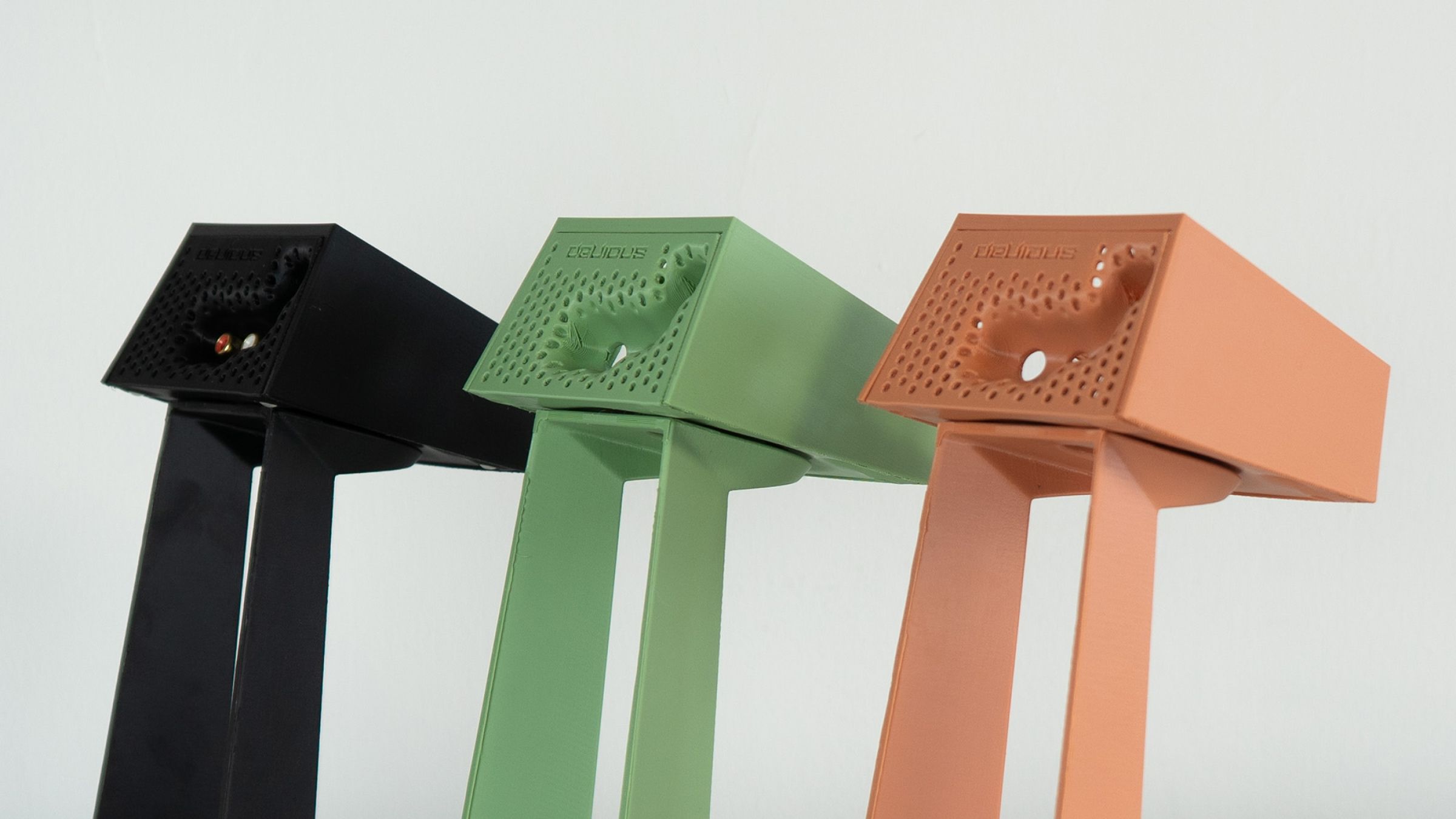
The enclosure is 3D-printed and swappable, with more colors and shapes promised. The firmware is closed for stability reasons, but NAP Works says development modules continue to flow back upstream into the open framework, and the off-the-shelf parts mean that if a unit ever needs repair you’re not waiting on a vendor’s mood.
Where the Devious Pocket gets complicated
No product comes without a few caveats worth flagging:
All control happens on a 4″ touchscreen, which is going to be polarizing depending on how attached you are to physical encoders. The real test will be in how the interface holds up under sweaty, low-light gig conditions over a long set.
If you’re a Rekordbox user, expect a wall on day one. The Devious Pocket reads ID3 tags but doesn’t import Rekordbox cue points, beatgrids, or hot cues. NAP Works has said Rekordbox tag support might come in a future firmware update, but at launch you’d be rebuilding library metadata or living without it.
Devices can’t currently be linked. Played tracks and USB-drive sharing isn’t going to be in these units, at least at launch. You’ll need two units and duplicate USB sticks. NAP Works has hinted device linking is on the roadmap, but it’s not in v1.
A microcomputer is still a computer. Yes, there’s very good reason to hope that a smaller, lighterweight system and firmware works better – but it still is the most probable point of failure (just like the laptop is in “classic” DVS).
Because of that design, building a two-deck rig means buying two boxes and the math jumps from €249 to €499 quickly. The two-deck bundle includes stands, but cables and control vinyl are still add-ons (€12.50 to €22.50 for cabling, €35 for a pair of Serato control records). Realistic out-the-door price for a two-deck rig with vinyl and proper cabling is closer to €570. Still well under half of a single CDJ-3000, but worth pricing properly before pulling the trigger.
Finally, the usual crowdfunding caveats apply, even though this isn’t really crowdfunding development. NAP Works is upfront that the product is fully developed and tested, components for the first 100 units are stocked, and they have in-house capacity for 5 to 10 units a day from a facility in Tilburg, Netherlands. It is still a small independent team in the EU, building units to order – which means that long-term support and ongoing development might not be a forever thing.
Standalone DVS: bigger than one box
NAP Works seems to have put together a solid package here, and they’ve built it on open-source tooling and off-the-shelf parts rather than the closed systems most DJ gear ships inside of these days. If the product takes off probably will depend on what the first units feel like in the hands of DJs who actually play out. The campaign closes in four days at nap.works or directly on Indiegogo, and made-to-order continues from the site after that.